
James did not want to get back in the car.
If you were only a passive spectator, that seems like it was the whole story. A toddler resisting a transition, putting up his best fight to stay put.
It felt like I was going against every natural instinct I had. Having to hand over a child who was reaching for me, in the only way his little mind knew how, hurts a father’s soul. What made it even harder was the way he reached. Not with an argument or a tantrum, but with the words he didn’t have yet.
But I was not a passive spectator. I was standing right there as his father. And the same way that mothers have maternal intuition, fathers have paternal instincts as well. So, it was easy for me to see that resistance was something else.
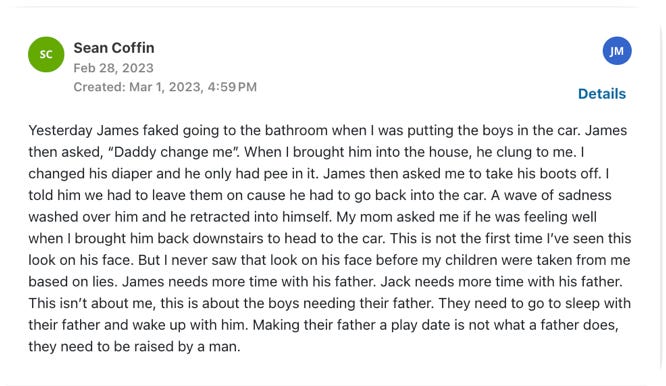
The day before I wrote that entry, I was putting the boys in the car when James said he had to go to the bathroom. Then it became, “Daddy, change me.”
So I brought James back inside.
James clung to me with his little grippy hands. I changed his diaper, which only had pee in it. Nothing urgent that should have been an emergency. Definitely nothing that should have required us to stop leaving.
But then he asked me to take his boots off.
I knew what he wanted. It was easy because I wanted it too.
I told him we had to leave them on because he had to go back into the car. The words hurt me to say out loud.
That is when his face changed.
That hurt even more.
Not a tantrum or defiance, but it was the silence that made it worse. A look that I could only describe as defeat. I hoped he wasn’t mirroring me. This was a toddler trying to navigate an emotion that he shouldn’t yet need to navigate.
Trying to express that he wanted to be with his father and not understanding why that was not possible. It’s something I’m still struggling to accept to this day. No child should be denied their parent. A child’s needs having to fit a parenting schedule defies the exact purpose of that parenting schedule.
A child’s needs.
A wave of sadness moved across him and he folded into himself. It passed immediately through me as well.
My mother saw it too. When I brought him back downstairs, she asked me if he was feeling well. I wanted to tell her James wasn’t sick. James was sad.
But as a parent, especially a parent whose time is scheduled and reliant upon courts, lawyers, and co-parents, there are things you cannot say in front of your children. Especially children who are too young to understand bigger emotions.
There are looks you learn as a parent, being able to read their face without words. The way a child looks when they’re hungry or the way a child looks when they have pushed far past their limit of tiredness. The look they give right before they have an inclination to chuck a toy airborne across the room. Toddlers are not subtle, they wouldn’t fair well robbing banks or acting as secret spies.
But this look was different. I had seen it before during this period, but I had never seen that look on his face before my children were taken from me based on false accusations. Narratives I knew were not true.
There are many people who believe that “seeing your children” is enough. “Are you getting parenting time?” As if a few court-approved hours equal being a real father. As if you should be grateful for whatever scraps survived the process.
Divorced dads are expected to treat access to their own children like a privilege. An acceptable reality that fathers have been tricked into believing is that if you get to see your children at all, you’re one of the lucky ones.
If you really got down to the core of the issue, that’s probably what has driven me most. To do all this writing, to publish a memoir, to fight and stand up for fathers. I feel I was meant to make an impact on people. I’ll be damned if someone was going to deny my own children that same opportunity.
I was trying to be their father. They talk about access and whether it’s, "your weekend.” They talk about compliance and transitions and temporary arrangements. It sounds clean, like the adults are simply moving chess pieces around a board.
But children are not chess pieces. Even when they can’t speak words or communicate, they can still feel. They feel love, safety, intention, and presence. They can also feel those feelings opposites.
They absorb the room, the positivity or the tension. They absorb the drop-off. They might not be able to understand why when time is up, it means time is up. They absorb the way one parent has to hand them back before anyone is ready. They do not understand affidavits or motion sequences. They don’t understand the heaviness when a parent is served right before your time with them. They do not understand why their father suddenly became someone they visit instead of someone that bathed them, went to sleep with them, woke up with them and lived life beside them. They don’t understand why their mother doesn’t just let them get out of the car and run into their grandparent’s house. They don’t understand why their father has to come and formally accept them first before they are granted entry.
To the court, it was access, but to James, it was leaving his father again.
And I knew it.
I wrote it down the next day. Not for any reason other than I needed there to be a record of the moment. I think I needed to write it down because it was the things that the court would never see. The emotion stood up and stood out to me, clear as day.
Not a legal argument or some polished version of grief prepared for court. Just what I expereienced as a man trying to navigate a form of fatherhood he never knew or experienced himself. My son tried to create one more minute with me.
A child faking a bathroom trip to steal some more time by using a diaper change that he didn’t need. And then the last “Hail Mary” attempt to turn a little time into more, by asking to have his boots taken off. Anything that could hit the brakes on the machinery he felt like he has no control over.
The thing was, he wasn’t the only one that counldn’t find the brakes. James wasn’t the only one that felt powerless to the machinery.
To someone who has never had their time with their children reduced to supervised windows and court-approved fragments, that may seem exaggerated.
That’s fine, consider yourself one of the lucky ones. I hope you never have to understand it.

The science is not exactly mysterious here.
Children build emotional security through repeated, reliable closeness with caregivers. A review published through the National Institutes of Health explains that attachment is specifically about making a child feel “safe, secure and protected,” and separates that from other parts of parenting like teaching, entertaining, or discipline. Another attachment review describes the caregiver as both a secure base for exploration and a haven of safety when the child is distressed.

This may sound clinical. In real life, it looks like a little boy asking for his boots to come off because taking them off might mean he gets to stay. Because prior to the children being taken from their home, Daddy was not just an everyday part of their life; he was a central part of their life. Mintute to minute, second to second.
If the relationship was different, I wouldn’t be writing. I wouldn’t be fighting. You wouldn’t hear from me. If I wasn’t such an integral part of their life, then the loss may not have been apparent to James and Jack.

That was the part no affidavit could measure.
No one was watching that face with a stopwatch. No one was writing down what it feels like when a child starts trying to figure out tricks to slow down time because the adults have made his father temporary.
This was never about making me feel “whole.” I was already being carved up by the process. I don’t know if “whole” will ever be a possibility. The best I can hope for is “changed but at peace.”
This was about two little boys who needed to fall asleep near their father and wake up with him. Fathers weren’t meant to be visited like a weekend exhibit. Children weren’t meant to be carried back and forth through adult conflict. It was never the job of a child’s little nervous system to make sense of it all.
A father can not be summed up into a playdate or a friend. A father’s role was always meant to be more than just a fun few hours. Those that haven’t had a father in their life will never understand what a father brings to a child’s life. A father is not something you schedule around when convenient.
Fathers are mean to be a part of the house. From the mornings, to making breakfast, through the ordinary daily messes that are made, to reading books before bedtime, and being there in the middle of the night to protect against bad dream and monsters in the closet. A father is meant to be the strongest person in a child’s world. A father is meant to be a child’s protector. A father is there to let them know they aren’t in danger.
That is fatherhood. That is the only way I know it. And that’s the only way I’ll accept it. For my children and for myself.
On that day, James knew exactly what was being taken. But he just didn’t have the words yet. But I understood James, message received. James told me, only way he possibly could…
…with a look.

My heart completely breaks for your boys. It's clear that James was doing everything he could to stretch out his time with you, which just shows how much he loves and needs his dad. Most parents only want the best for their kids, and it’s heartbreaking that your time is restricted like this. I am praying things change soon and the courts grant you much more time with those precious boys.
This made my very sad. Using children as pawns for any reason is disgusting and detrimental to the child. They should open their eyes, push aside the hate and control need and do what is right for the kids…let you have consistent long term time with them.